Middle English (earlier as pike, which continues in dialect use): of unknown origin.
Compare with Dutch pikken ‘pick, peck’, and German picken ‘peck, puncture’, also with French piquer ‘to prick’.
I reached out and picked up a magazine. 집다
(Informal) As usual, we had to pick up the tab. (계산서·값을) 지불하다
Will you pick the children up from school? 데리러 가다 / 가지러 가다
She picked him up on one niggling point. 트집잡다, (사소한 결점을) 지적하다
Songs to pick you up and make you feel good. 기운을 복돋우다
After the failure, Emily picked herself up and tried again. 다시 일어서다 / 재기하다
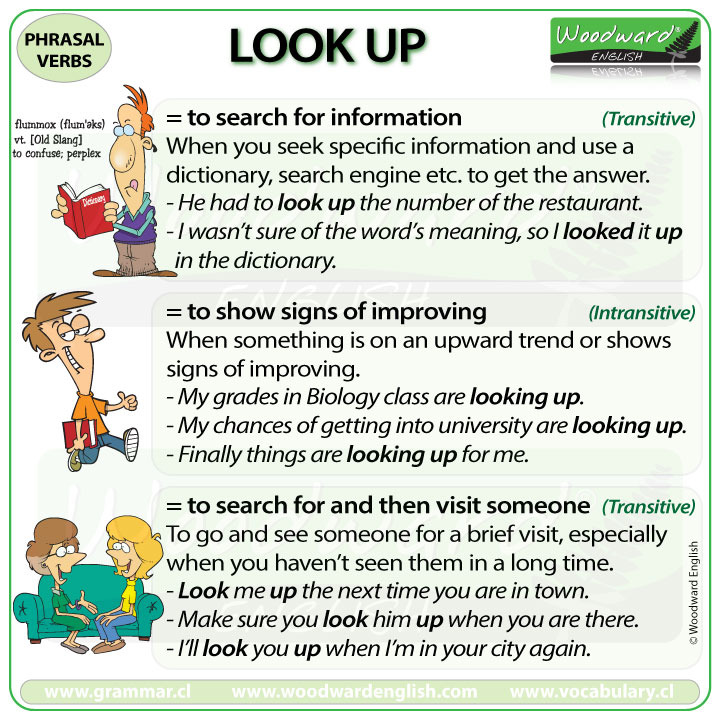
출처 : Woodward - look up
look it up : 의도적으로 시선을 두다(look) + 위 (up)
어원
comes from Old English lōcian, meaning "to see, gaze, or behold," originating from Proto-West Germanic lōkōn,
She looked up and saw the plane overhead. (고개·시선을) 위로 들다
I'll look up the word in the dictionary. (정보를) 찾아보다, 조회하다
If you're ever in Seoul, look me up. (사람을) 찾아가다 / 방문하다
Things are finally looking up for him. (상태 · 상황이) 나아지다
find vs. search vs. look up
find : 결과 중심 (찾아냈다)
search : 과정 중심 (찾고 있다)
look up : 이미 존재하는 정보를 체계 속에서 정확히 조회하다
출처 : English Picture Dictionary - Try on
try on : 시험하다, 판별하다 (try) + 접촉 (on)
어원
Middle English: from Old French trier ‘sift’ (채로 거르다, 면밀히 조사하다)
She tried on the jacket in the store.(옷·신발·장신구를) 입어보다
He's trying on the role of team leader. (외형·이미지·역할을) 시험 삼아 적용해보다
He tried on a polite tone to see how she'd react. (말·태도·핑계를) 시험적으로 사용해 보다
출처 : Dreamstime.com - Fed Up 2 stock illustration..
be fed up with : 짜증나는 상황 중 제일 강한 표현
I'm fed up with my job.
I'm fed up with cleaning up after you all the time.
throw away : 힘을 주어 던지다 (throw) + 멀리 떨어트리다 (away)
버리다, 낭비하다
knock over : 부딪혀 충격을 주다 (knock) + 넘어간 상태 (over)
(물건을) 넘어뜨리다
(사람을) 치어 넘어뜨리다
강도질하다
go off : 상태 변화 (go) + 이탈 (off)
(폭탄·알람) 작동하다
(음식이) 상하다
(사람이) 갑자기 화내다
(이벤트가) 예정대로 진행되다
show around : 보게 하다(show) + 순환 (around)
(사람에게 장소를) 안내하다
(새 환경을) 소개하다
인물과 사물에 따라 다른 전치사 사용
angry about sth vs. angry at sbd
angry/mad about something
Are you angry about last night?
angry/mad at somebody
Why are you mad at me? What did I do?
nice of vs. nice to
nice / kind of somebody to ...
It was nice of you to help us. Thank you very much.
be nice / kind to somebody
David is very friendly. He's always very kind to me.
English Words
influence : 흘러 들어가다
발음 : [ˈɪnfluəns ]
어원
late Middle English: from Old French, or from medieval Latin influentia ‘inflow’, from Latin influere, from in- ‘into’ + fluere ‘to flow’.
The word originally had the general sense ‘an influx, flowing matter’, also specifically (in astrology) ‘the flowing in of ethereal fluid (affecting human destiny)’.
The sense ‘imperceptible or indirect action exerted to cause changes’ was established in Scholastic Latin by the 13th century, but not recorded in English until the late 16th century.